A small bedroom does not have to feel cramped or cluttered. In most homes the problem is not the size of the room—it is how much of the room is quietly doing nothing. The wall above the dresser, the space under the bed, the back of the door, the top shelf of the wardrobe: every one of them can carry part of the load.
The ideas below are about making each part of a small bedroom work harder. That means better storage systems, more vertical organization, furniture that earns its footprint, and a couple of simple routines that keep the room calm once it is organized. Nothing here requires a renovation, and almost all of it is renter-friendly.
1. Make Your Wardrobe Work Harder
Most wardrobes waste a surprising amount of vertical space. A single rail and one high shelf leave big gaps above the shelf and below the hanging clothes—and those gaps are exactly where a small bedroom finds extra storage.
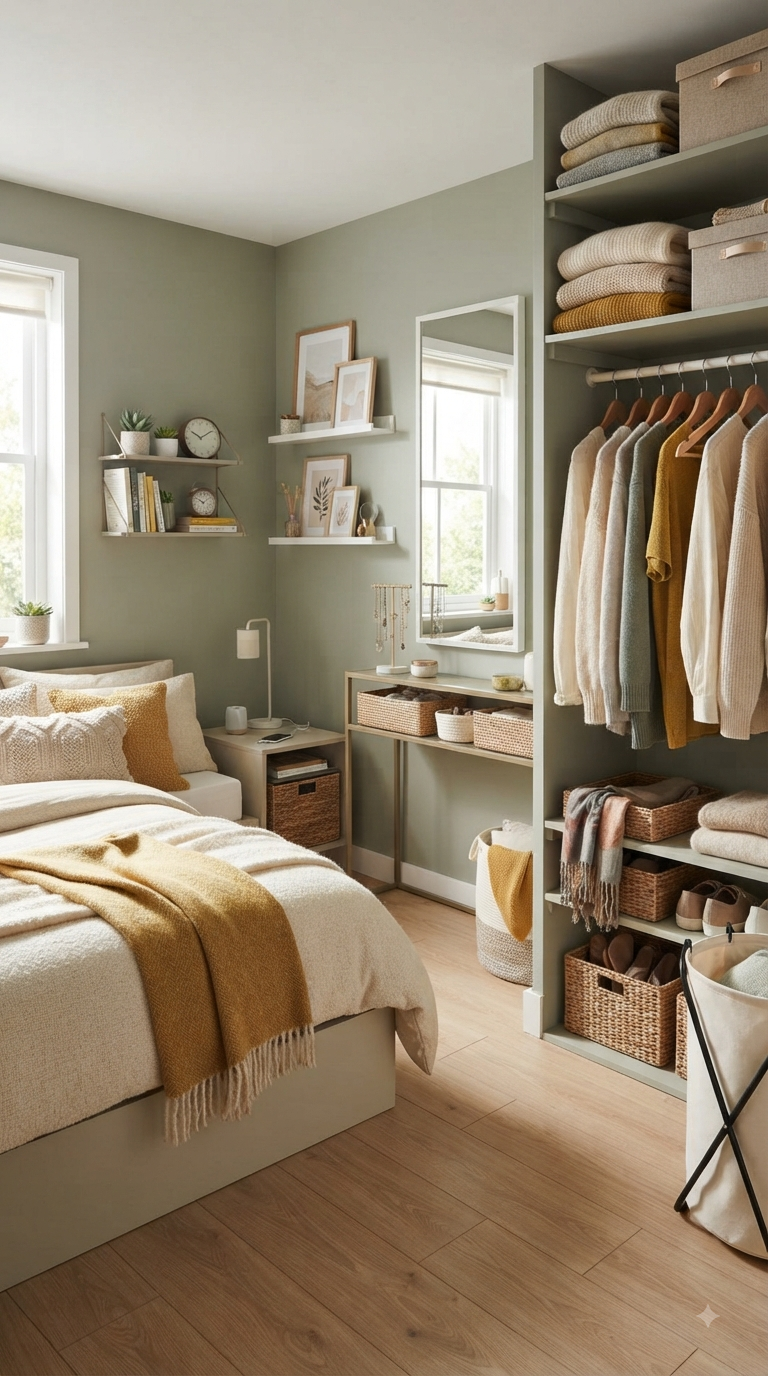
Add a second shelf or stackable storage boxes above the rail for things you rarely reach for. Use baskets to group accessories on shelves, and shelf dividers to keep folded stacks from toppling into each other. If there is empty air beneath short hanging items, a small drawer unit or a row of boxes slots in neatly.
Then organize by height, so the wardrobe matches how often you actually use things:
- Eye level and the front of the rail: clothes you wear every week.
- Above the shelf line: labeled boxes for seasonal and occasional items.
- Below the rail: shoes, a laundry basket, or low drawers.
Keeping frequently used items at accessible heights is what makes the system survive a busy week—nothing gets dumped on the chair because nothing is hard to put away.
2. Use the Space Under Your Bed
The area under the bed is usually the largest unused surface in a small bedroom, and it is perfectly suited to the things you need sometimes but not every day: spare bedding, out-of-season clothing, shoes, handbags, and extra blankets.
Low, lidded boxes or zip-top storage bags keep everything clean and dust-free, and they slide out without a fight. Label the end that faces outward so you never have to pull out three boxes to find one duvet cover. If your bed frame sits too low for storage, bed risers can quietly create the clearance.
The principle is the same one behind our full guide to small-space storage ideas: give the overlooked inches a clear job, and the rest of the room relaxes.
3. Add Storage to Empty Wall Space
Floor space is scarce in a small bedroom; wall space usually is not. Floating shelves above a dresser or desk hold books, baskets, and everyday objects without claiming a single centimetre of floor. A row of wall hooks near the door takes care of a robe, a bag, and tomorrow's outfit.
Narrow shelving fits the awkward slivers beside a wardrobe or window. A small pegboard can organize jewellery, hats, and accessories while keeping them visible. Hanging organizers add pockets to the inside of a wardrobe or along a rail.
Two things keep wall storage calm rather than busy: choose fewer, larger pieces instead of many small ones, and anchor anything that carries weight properly into the wall. For more room-by-room ideas like this, browse our small spaces section.
4. Use Baskets to Control Small Items
Small items are what make a small bedroom look untidy—chargers, scarves, socks that have not found their drawer, the pile of things that belong “somewhere.” Baskets solve this by grouping like with like: one basket for accessories, one for extra throws, one for whatever category keeps ending up loose.
Woven or lidded baskets do double duty, because they hide visual noise while still keeping things within reach. A large floor basket beside the bed swallows spare blankets in one motion. The rule that keeps the system honest: one basket, one category—and when a basket is full, it is time to edit, not to buy another basket.
Smart Space Tip: Measure before you buy. Note the height and depth of the shelf or gap first—baskets that fit the space exactly look built-in and waste nothing.
5. Make Use of the Back of Your Door
The back of the bedroom door is prime storage that most rooms ignore. An over-the-door organizer with pockets can hold shoes, scarves, belts, small bags, and accessories—and clear pockets mean you can see everything at a glance instead of digging.
Keep the profile slim so the door still closes comfortably, and load it with lightweight items rather than anything that rattles. If pockets feel like too much, even a simple over-door hook rail earns its place: it is exactly the right spot for pajamas, a towel, or the outfit you have planned for tomorrow.
6. Choose Furniture With Built-In Storage
In a small bedroom, every piece of furniture should earn its footprint twice. A bed with built-in drawers—or a lift-up storage base—is the single biggest upgrade, because it turns the largest object in the room into the largest storage unit in the room.
From there, the same thinking applies everywhere. A storage ottoman or bench at the foot of the bed holds spare bedding and gives you somewhere to sit. A bedside table with drawers works harder than one with open legs. A blanket box doubles as a windowsill seat or a place to drop a tray.
When you can choose, prefer storage that closes. Closed storage keeps surfaces quiet, and quiet surfaces are what make a small room feel bigger than it is.
7. Organize Your Drawers by Category
Drawers become cluttered for one simple reason: they hold too many categories at once. When socks, chargers, paperwork, and t-shirts share one drawer, the drawer stops having a job—it just has contents.
Give each drawer a single category, then use drawer dividers or small open boxes to hold the shape of the system. Folding clothes upright, file-style, instead of stacking them flat means you can see every item the moment the drawer opens—and taking one out does not disturb the rest.
While you are in there, relocate anything that is not clothing. Bedroom drawers work best when the miscellaneous things have their own basket elsewhere.
8. Keep Your Bedside Area Simple
The bedside table sets the tone for the whole room, because it is the surface you see first in the morning and last at night. In a small bedroom it deserves a strict guest list: a lamp, the book you are actually reading, a glass of water, and a place for your phone to charge.
Everything else lives in the drawer or moves elsewhere. A clear surface reads as space—the room instantly feels calmer and larger. A thirty-second tidy of the bedside area each night is one of the highest-return habits in this whole list.
9. Give Your Clothes a Better System
A small wardrobe does not need fewer clothes so much as a clearer system. Start by sorting into categories—tops, trousers, occasion wear—and then, inside each category, by how often you reach for things.
The prime real estate of the wardrobe—eye level, the front of the rail, the easiest drawer—belongs to the current season and the pieces you wear weekly. Occasion wear and out-of-season clothing move to the high shelf, the awkward corner, or those under-bed boxes from idea two. Swapping the rotation twice a year keeps the everyday zone genuinely everyday.
Two small habits protect the system: keep a small bag or basket in the wardrobe for pieces you are ready to donate, and when something new comes in, let something else go out.
10. Create a Small Bedroom Reset Zone
Every bedroom has daily drift: the receipts and hair ties, the jewellery taken off at night, the cardigan that is not dirty but not ready to be put away. Fighting the drift item by item is exhausting—so give it a destination instead.
Choose one basket, tray, or box as the room's reset zone. Through the day, temporary clutter is allowed to land there—and only there. Then, once a day, a short five-minute reset returns everything in the container to its proper place.
Keep the container deliberately small. A small tray forces the reset to happen; a large basket just becomes long-term storage with a nicer name. The point is not that clutter never appears—it is that clutter has one address, instead of every surface in the room.
Smart Space Tip: Put the reset tray where clutter already lands—usually the top of the dresser or that one chair. You are not fighting the habit; you are giving it a container.
Make Your Small Bedroom Work Better
A small bedroom rarely needs more furniture. It needs better systems: vertical space that carries its share, hidden storage under the bed and inside the furniture, baskets that give small things a home, and one or two simple routines that keep it all standing.
Start with a single drawer or one shelf tonight. Small wins compound quickly in a small room—each cleared surface makes the next one easier, and the whole bedroom begins to feel calmer, bigger, and easier to live in.
When you are ready for the next project, keep going with our guide to 10 genius small-space storage ideas, or explore more practical ideas for small-space living, home organization, kitchen organization, and smart home finds.