Your bedside area may be one of the smallest spaces in your bedroom, but it has an important job.
It’s where you reach for your phone before getting up in the morning. It’s where your book rests at night. It’s where you may keep your glasses, charging cable, water bottle, hand cream or other everyday essentials.
When there isn’t enough storage, the bedside table can quickly become a cluttered collection of things you use every day.
And because it’s one of the last things you see before going to sleep and one of the first things you see when you wake up, a messy bedside area can make the entire bedroom feel less organized.
The good news is that you don’t necessarily need a large bedside cabinet.
With the right storage approach, even a small bedside area can be practical, attractive and easy to maintain.
Here are 11 bedside storage ideas worth considering.
1. Choose a Bedside Table With Drawers
A bedside table with drawers is one of the simplest ways to keep everyday essentials close without leaving everything on display.
The top can hold the things you use frequently, while the drawer provides a home for smaller items.
You could use it for:
- Charging cables
- Reading glasses
- Hand cream
- Medication organizers
- Earphones
- Remotes
- Small personal items
The advantage is that the surface stays relatively clear while everything remains within reach.
Look for the right proportions
In a small bedroom, a compact bedside table may be more appropriate than a large nightstand.
Measure the available space beside your bed before choosing one.
You want enough storage to be useful without making the walkway feel cramped.
2. Use a Narrow Bedside Cabinet
If your bedroom doesn’t have enough room for a conventional nightstand, consider a narrower cabinet.
A slim cabinet can provide some of the same benefits while taking up less floor space.
This can work particularly well beside:
- Small double beds
- Beds positioned close to a wall
- Compact guest bedrooms
- Apartment bedrooms
- Narrow bedrooms
A narrow cabinet with a door can also conceal belongings and keep the area visually calm.
3. Try a Wall-Mounted Bedside Shelf
When floor space is extremely limited, take the storage off the floor.
A wall-mounted shelf beside the bed can provide enough space for a few essentials without requiring a traditional nightstand.
Depending on the size, you could use it for:
- A small lamp
- Your current book
- Phone
- Glasses
- A small decorative item
Keep the shelf intentionally simple
Because the shelf is visible, avoid treating it like a general storage area.
Choose only the things you genuinely want within reach.
A small amount of carefully arranged storage can look much better than a shelf packed with belongings.
4. Use a Bedside Caddy
A bedside caddy can be particularly useful if you don’t have room for a nightstand at all.
These organizers can hang from or attach to the side of a suitable bed and provide compartments for smaller belongings.
Depending on the design, you might use one for:
- Books
- Tablets
- Phones
- Charging cables
- Glasses
- Remotes
- Headphones
This makes use of an area that would otherwise remain unused.
Check compatibility first
Make sure the caddy is suitable for your bed frame and mattress arrangement.
You also want to ensure it doesn’t interfere with movement or become uncomfortable when you’re getting into bed.
5. Add a Small Drawer Unit
A compact drawer unit can provide more storage than a basic bedside table while still fitting into a relatively small footprint.
This can be particularly useful if your bedside area tends to accumulate many small belongings.
Use individual drawers for different categories.
For example:
- Top drawer: everyday essentials
- Second drawer: electronics and cables
- Third drawer: personal accessories
The exact arrangement will depend on your routine.
The important part is giving each category a predictable home.
6. Use a Small Basket Under the Nightstand
The space beneath a bedside table doesn’t necessarily have to remain empty.
A small basket can provide additional storage while keeping belongings contained.
It’s particularly useful for softer items such as:
- Extra blankets
- Books
- Sleep accessories
- Small bags
- Slippers
A basket can also be easier to move than a heavy storage box.
Don’t overcrowd the floor
This is important.
If the basket makes it difficult to move around the bed, it’s defeating the purpose.
Use the space underneath the nightstand only when there is enough clearance to maintain a comfortable walkway.
One drawer, four homes
08
7. Install a Small Wall Shelf Above the Bedside Area
If the wall beside your bed is available, a second level of storage can make use of otherwise unused vertical space.
A small shelf positioned above or beside the nightstand can hold suitable lightweight items such as:
- Books
- Small baskets
- Decorative objects
- A small plant
However, placement matters.
Avoid positioning shelves where they could become an obstruction or where stored objects could easily fall onto the bed.
For bedrooms, safe positioning should always come before maximizing storage.
8. Use Drawer Dividers Inside Your Nightstand
Sometimes the problem isn’t insufficient storage.
It’s that the storage isn’t organized.
A bedside drawer can become chaotic surprisingly quickly.
A few simple dividers can separate small belongings into dedicated compartments.
For example:
- Charging accessories
- Glasses
- Pens
- Personal care items
- Remotes
- Small electronics
This makes it much easier to find what you need without emptying the entire drawer.
Keep the categories practical
Don’t create ten different compartments for ten different objects.
Group similar things together so the system remains easy to maintain.
9. Choose a Bedside Table With a Shelf
A bedside table doesn’t necessarily need drawers.
A lower shelf can provide useful open storage for books, baskets or other items.
This design can work especially well if you like having your current books close by.
You can also place a basket on the lower shelf to combine open and concealed storage.
Keep the top surface calm
A shelf underneath gives you more storage, but that doesn’t mean the tabletop should become crowded.
Ideally, the top should remain useful for the few things you reach for most often.
10. Use a Storage Headboard
If you’re choosing a new bed, consider whether a storage headboard could provide another opportunity for organization.
Some headboards incorporate:
- Small shelves
- Compartments
- Side storage
- Built-in ledges
This can reduce the need for additional bedside furniture.
It’s particularly useful when the bedroom layout doesn’t provide much space beside the bed.
Think about accessibility
Storage that is built into the headboard can be convenient for books and small nighttime essentials.
But don’t use high or difficult-to-reach compartments for things you need frequently.
The most useful storage is storage you can actually access comfortably.
11. Use a Small Tray to Contain Everyday Essentials
Not every storage solution needs to be furniture.
Sometimes a simple tray can make a bedside area significantly more organized.
Instead of allowing several small objects to spread across the tabletop, place them together in one designated area.
A tray can hold things such as:
- Your watch
- Glasses
- Hand cream
- Small accessories
- A phone
- Other nighttime essentials
It creates a visual boundary that helps prevent small objects from taking over the entire surface.
The tray isn’t the storage system
Think of it as a daily landing zone.
When something belongs somewhere else, return it to its proper place rather than letting the tray become a permanent dumping ground.
How to Decide Which Bedside Storage You Need
Before buying anything, take a look at what currently collects around your bed.
Is it mostly books?
You may need a shelf.
Are there lots of small personal items?
A drawer unit could be more useful.
Is there no room for a nightstand?
A wall shelf or bedside caddy might make more sense.
Are cables the main problem?
A drawer organizer or dedicated cable-management solution may be enough.
The best bedside storage is the one that addresses your actual source of clutter.
Don’t Let Bedside Storage Become Bedside Clutter
Adding storage can sometimes create a new problem.
You buy a larger nightstand, fill the drawers and then start putting even more things into them.
More storage isn’t automatically better.
The goal is to create a simple system that helps you keep the area under control.
A good rule is:
Keep the things you regularly use close. Store everything else somewhere else.
Your bedside area doesn’t need to become an extension of your entire bedroom.
What Should You Keep Beside Your Bed?
There’s no universal list, but most people can benefit from keeping only a few everyday essentials nearby.
For example:
- A reading light
- Current book
- Phone
- Charging cable
- Glasses
- Water
- One or two personal essentials
Everything else can have another home.
This keeps the area functional without making it visually overwhelming.
Small Bedroom? Make the Bedside Area Work Harder
In a small bedroom, every square inch matters.
Instead of automatically adding a larger nightstand, consider whether you can combine several storage functions.
For example:
Combination one
Wall shelf + small basket
or
Combination two
Drawer nightstand + under-table basket
or
Combination three
Storage headboard + slim bedside table
The idea is to use available vertical and hidden space without overcrowding the room.
Make Your Bedside Storage Match the Bedroom
Function matters most, but appearance still matters.
Because the bedside area is visually prominent, storage that works with your bedroom’s overall style can make the room feel more cohesive.
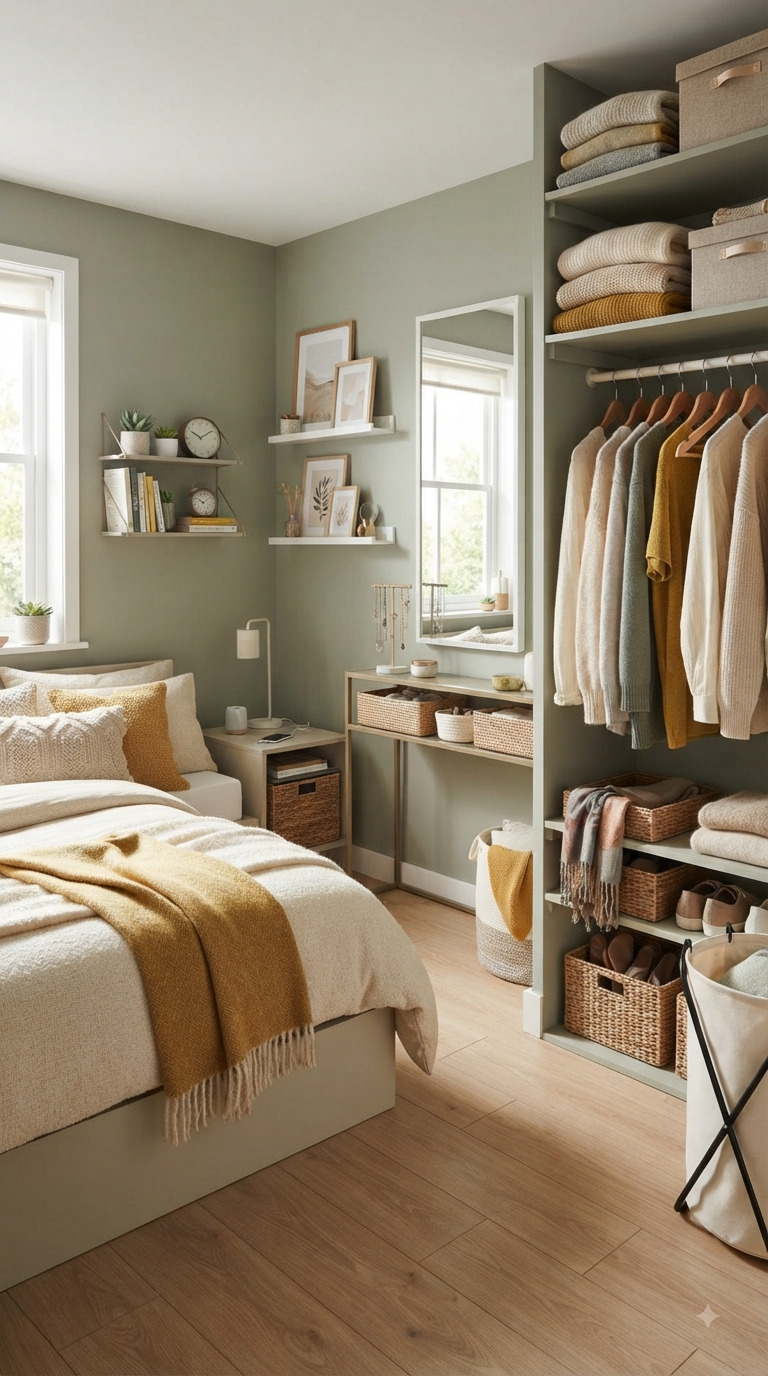
Natural wood, woven baskets, soft neutral finishes and simple shapes can work particularly well in a calm bedroom.
But don’t feel obligated to make everything perfectly matching.
A coordinated look is usually enough.
A Simple Nightly Bedside Reset
One of the easiest ways to keep this area organized is to create a tiny evening reset.
Before going to sleep:
- Return books to their usual place.
- Put glasses in their designated spot.
- Remove cups or bottles that don’t belong there.
- Put loose accessories into the drawer or tray.
- Return charging cables to their designated location.
- Clear anything that has accumulated during the day.
It should only take a few minutes.
The benefit is that you wake up to a cleaner, calmer bedside area rather than yesterday’s clutter.
Final Thoughts
Your bedside area doesn’t need to be large to be useful.
A compact drawer, wall shelf, bedside caddy, basket or even a simple tray can provide enough organization to keep everyday essentials under control.
The key is to choose storage based on what you actually use.
Don’t buy a large nightstand simply because it offers more drawers.
Don’t fill every available shelf.
And don’t turn your bedside area into a storage zone for the entire bedroom.
Instead, create a small, intentional system where the things you need most are easy to reach, easy to put away and easy to find.
Smart Space Finds takeaway
The best bedside storage doesn’t just hold more things—it makes your nighttime and morning routines easier.
Start with the items that constantly collect beside your bed, then choose the smallest storage solution that solves the problem.
For more ideas in the same spirit, explore the bedroom section, or keep going with our guide to 10 genius small-space storage ideas and the small spaces and home décor sections.