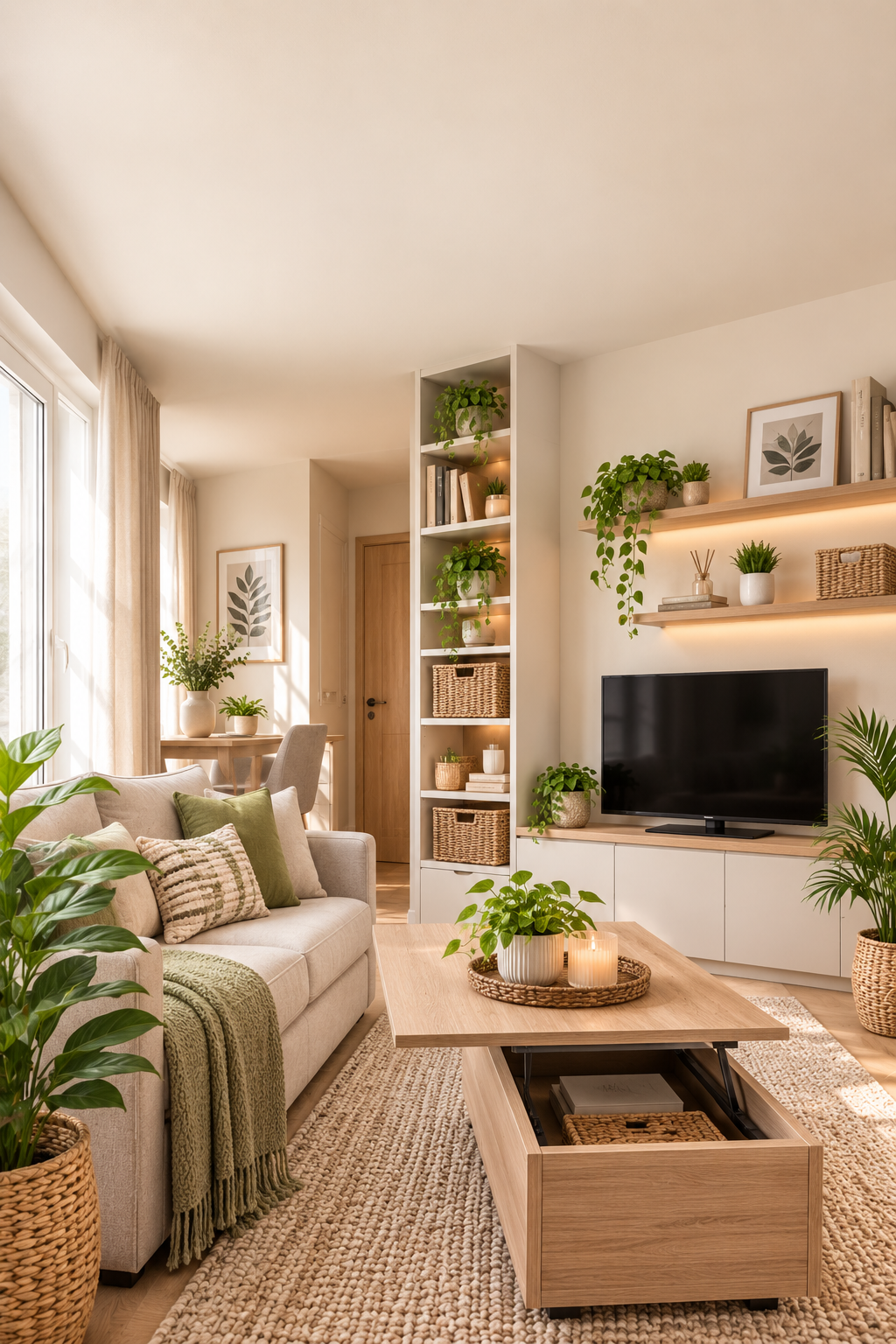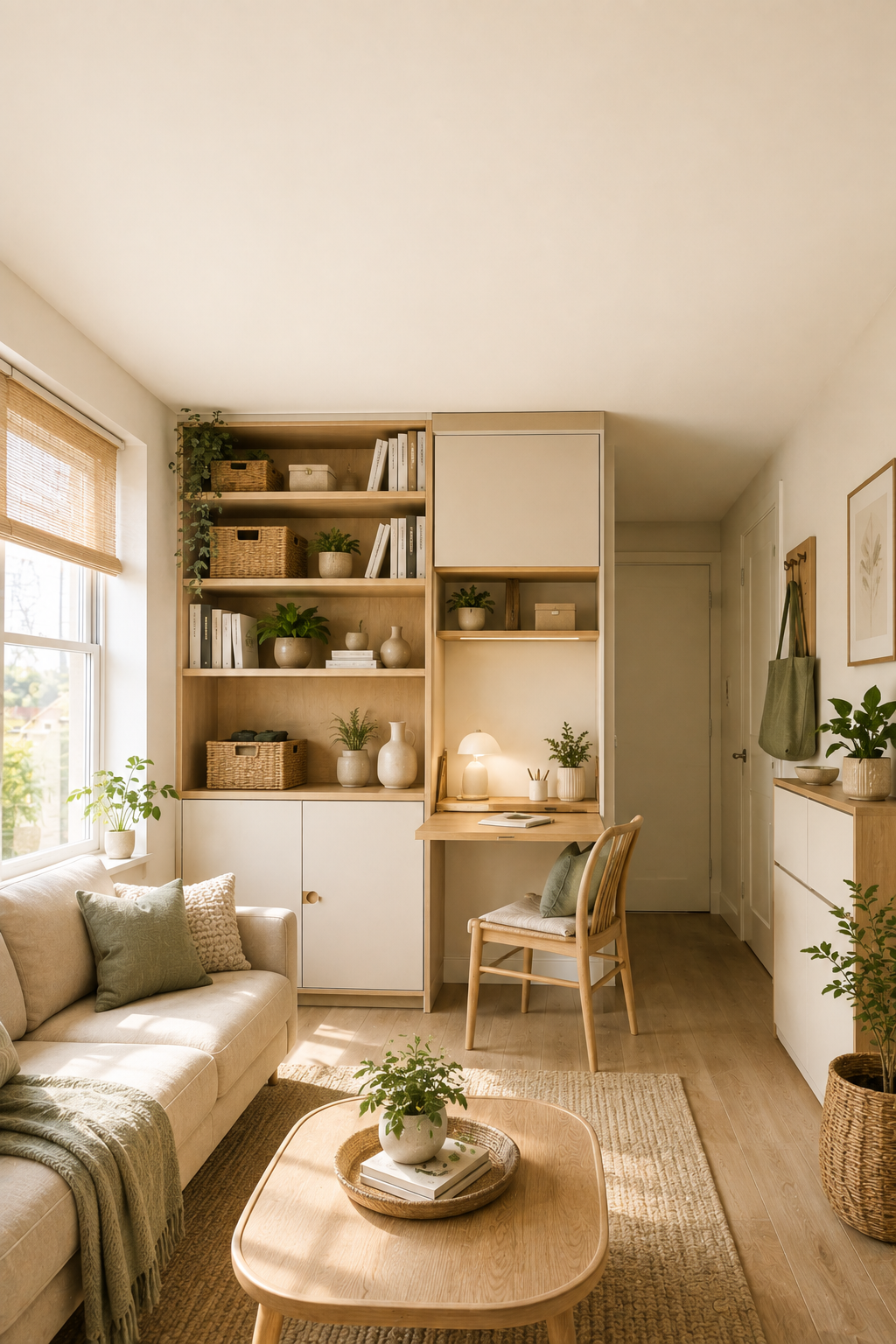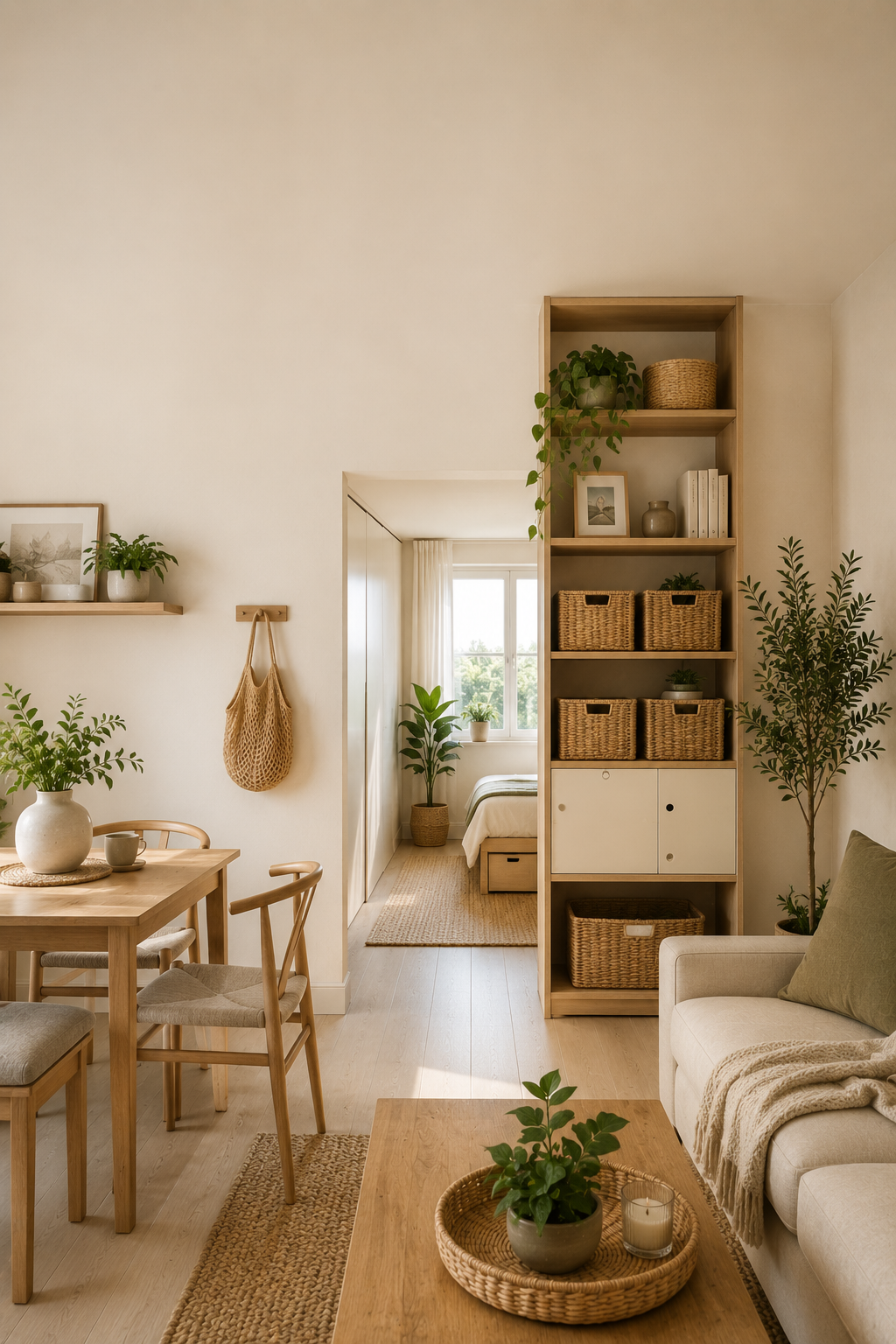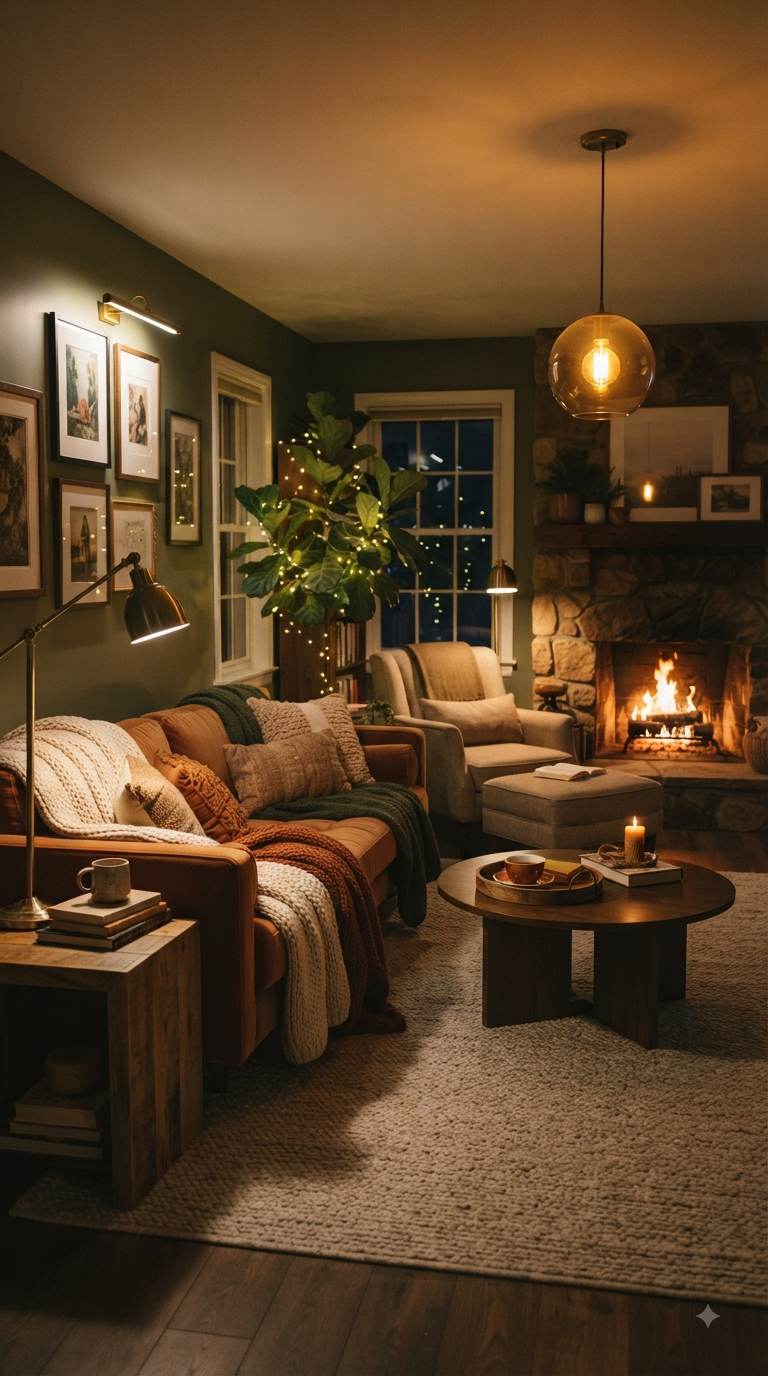
Few things change the atmosphere of a living room as quickly as light. The same sofa, the same walls, and the same shelves can feel flat and slightly clinical under one bright overhead bulb—or soft, layered, and genuinely inviting once the light comes from a few warm sources at different heights.
That is the whole idea behind warm, layered lighting: instead of one light doing everything badly, several gentle lights each do one job well. It is also the most affordable redesign there is. Most of the ideas below cost little or nothing, none of them require an electrician, and you can feel the difference the same evening.
1. Add a Warm Floor Lamp
A floor lamp earns its place in almost every living room, because it brings light down from the ceiling to human height—where cozy actually happens. The best positions are the ones a ceiling light cannot reach: beside the sofa, behind a reading chair, or in the dark corner the overhead light never quite touches.
Corners matter more than they seem. A dim corner visually shrinks a room; a softly lit one opens it back up. Choose a lamp with a fabric or diffusing shade rather than an exposed bulb, so the light lands as a glow instead of a glare, and fit it with a warm-toned bulb—more on that in idea three.
If the lamp is next to seating, aim for the bottom of the shade to sit around eye level when you are seated. Higher, and it lights the room; lower, and it lights your lap. Both are useful—decide which job this lamp is for.
2. Use Table Lamps to Create Cozy Corners
Table lamps are how a living room gets its pools of light—the small, warm islands that make a space feel layered instead of uniformly lit. They belong beside sofas and armchairs, on consoles, on sideboards, and on side tables that would otherwise just hold a coaster.
Each pool of light quietly defines a little zone: this is where you read, this is where you set your tea, this is the corner that glows in the evening. Two smaller lamps in different spots almost always beat one large one, because the room gains depth—your eye moves between warm points instead of stopping at a single bright source.
A pair of matching lamps on a console or sideboard adds a touch of calm symmetry, while a single lamp on a side table keeps things relaxed. Either way, the goal is the same: light where people actually sit.
3. Choose Warm-White Bulbs
The single fastest change on this whole list is the bulb itself. Light color is measured in kelvins, and the number is printed on every bulb box: lower numbers are warmer, higher numbers are cooler.
Around 2700K is classic warm white—the golden, relaxed glow of a traditional incandescent bulb, and the sweet spot for living rooms. Around 3000K is a slightly fresher soft white. Once you reach 4000K and above, light turns cool and blue-toned; it is useful over a workbench or in a laundry area, but in a living room it reads as harsh and slightly clinical, no matter how lovely the furniture is.
Consistency matters as much as the number. One cool bulb in a warm room draws the eye like a wrong note, so when you replace bulbs, bring the whole room to the same warm temperature.
Smart Space Tip: Check the kelvin number, not the wording. “Warm white” labels vary between brands, but 2700K is 2700K everywhere—matching that number across every lamp in the room is the quickest coziness upgrade there is.
4. Layer Your Lighting
A cozy living room almost never relies on a single light source. The rooms that feel effortlessly warm are layered—several kinds of light, at several heights, each with its own job:
- Overhead lighting provides the base layer. Keep it soft or dimmed; it should support the room, not dominate it.
- Floor lamps lift light into dark corners and give seating areas their glow.
- Table lamps create the mid-level pools that make evenings feel intimate.
- Accent lighting—a picture light or a small shelf lamp—adds depth and draws the eye to what you love.
Three sources is a good minimum for a living room; many cozy rooms use four or five small ones rather than one or two strong ones. Layers also make the room flexible: all layers on for cleaning and busy moments, lamps only for a quiet evening.
5. Highlight Artwork
Gentle, directional light turns a picture on the wall into a focal point after dark. A slim picture light mounted above a frame, or a small spotlight angled from nearby, washes the artwork in warmth and gives the whole wall a reason to be looked at.
The keyword is gentle. This is an accent, not a gallery installation: the beam should be warm, soft-edged, and only slightly brighter than the wall around it. If the piece sits behind glass, angle the light from above or the side so you admire the art rather than a reflection of the lamp.
One well-lit picture is usually enough. Its quiet glow adds a layer of depth to the room that overhead lighting simply cannot create.
6. Light a Reading Corner
A reading corner is the smallest room-within-a-room you can build, and it takes exactly three pieces: a comfortable chair, a small side table, and a lamp. That trio turns an unused corner into a destination—somewhere to sit with a book, a coffee, or ten quiet minutes.
Place the lamp beside or slightly behind the chair, with light falling over your shoulder onto the page rather than into your eyes. A floor lamp with a downward shade or a table lamp at seated eye level both work beautifully.
This idea pulls real weight in compact homes, where one corner often has to justify itself. If that is your situation, explore more ideas for small-space living.
7. Use Lamps as Decorative Pieces
A lamp works two shifts. In the evening it makes light; all day long it sits in the room as an object—which means the lamp itself can carry real decorative weight. A sculptural ceramic base, a woven rattan shade, a slim brass stem, or a soft linen drum each say something about the room even when switched off.
Choose lamps the way you would choose a vase or a bowl: in materials and tones that echo what the room already loves. And let one lamp be the statement while the others stay quiet—a single characterful piece reads as style, while five competing ones read as clutter.
8. Don’t Forget Natural Light
Cozy is not only an evening project. During the day, the window is the best lamp in the room—and curtains decide how its light behaves. Sheer or light-filtering curtains soften harsh midday sun into a gentle, even glow, while heavier curtains in warm, natural fabrics frame the window and add texture.
Hang the rail wider and higher than the window itself, so the curtains stack against the wall when open and the whole pane stays clear. Keep the glass and the sill reasonably uncluttered, and if the room is naturally dark, a mirror placed opposite or beside the window quietly bounces daylight deeper into the space.
A room that is softly lit by day and warmly lit by night keeps the same character around the clock—which is exactly what makes it feel settled.
9. Use Dimmers Where Possible
A dimmer lets one room live two lives. Full brightness for cleaning, board games, and finding the remote; a low, golden setting for the last slow hour of the evening. No other single control does as much for atmosphere.
If you can change a wall switch, a dimmer switch is a modest upgrade with a daily payoff. If you rent, there are gentler routes to the same result: lamps with built-in dimmers, plug-in dimmer controls that sit between the lamp and the socket, and smart bulbs that dim from your phone—a natural first step if you are curious about smart home ideas.
One practical note: not every bulb is dimmable, and pairing the wrong bulb with a dimmer causes flicker. The word “dimmable” on the box is what you are looking for.
10. Combine Lighting With Warm Materials
Warm light needs something warm to land on. The same golden lamp glow that disappears against bare, glossy surfaces comes alive on wood, linen, woven textures, and soft neutral tones—materials that hold light instead of bouncing it back.
This is why the coziest corners are usually little partnerships: a lamp beside a wooden side table, a pool of light falling on a textured throw, neutral cushions catching the glow, a woven basket warming up the floor beneath a floor lamp. Plants join in beautifully too—leaves add gentle shadow and a bit of life at the edge of every pool of light.
You likely own most of these ingredients already; they may just be scattered. Gather a few of them into the same corner as a lamp and watch the corner change.
Smart Space Tip: Shop your home first. Move an existing lamp, a throw, and a plant into one corner for an evening and judge the effect—before deciding whether the room actually needs anything new.
A Warmer Room Without a Redesign
A cozy living room is rarely the result of new furniture. It is the result of light: warm bulbs instead of cool ones, a few sources at different heights instead of one bright ceiling fixture, a dimmer for the evenings, and textures that give the glow somewhere to land.
Start with the easiest wins—swap the bulbs, move a lamp into a dark corner, switch the overhead light off after dinner—and let the room show you the difference tonight. Then explore more practical ideas in home décor, small-space living, and home organization.