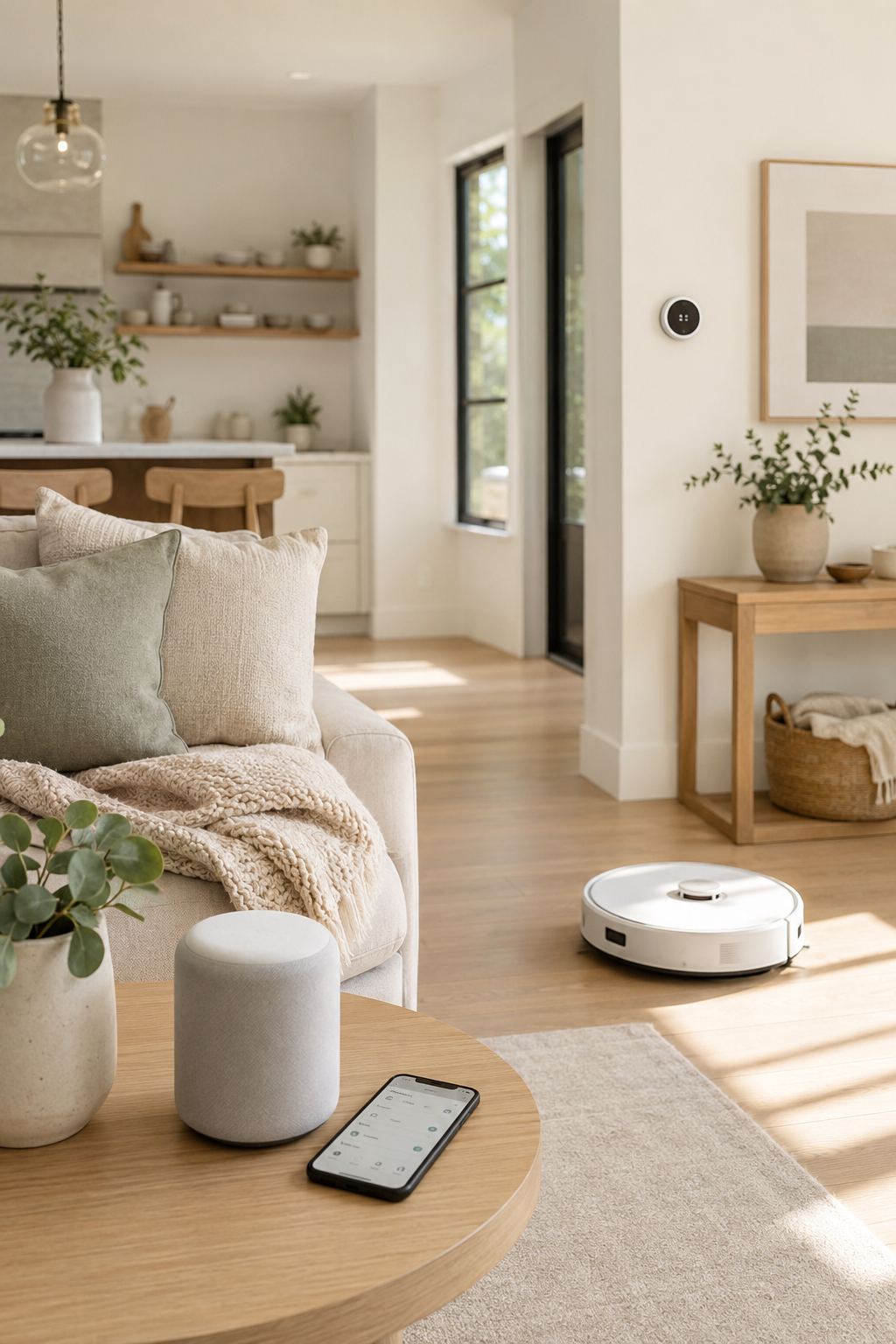
Smart-home technology can sound complicated when you look at everything that’s available.
There are smart lights, speakers, plugs, sensors, locks, thermostats, cameras, appliances and countless other connected products.
But you don’t need a house full of technology to benefit from a smarter home.
The most useful devices are usually the ones that remove a small inconvenience from your everyday routine.
Maybe you’re tired of coming home to a dark apartment.
Maybe you constantly forget to switch off a lamp.
Maybe you want a reminder when a door opens.
Maybe you’d simply like your floors cleaned while you’re doing something else.
These are the kinds of problems where smart devices can make sense.
The key is to choose technology based on what you want your home to do more easily, rather than buying devices simply because they’re clever.
Here are eight smart-device categories worth considering.
01. Smart Bulbs for More Flexible Lighting
Smart bulbs are one of the simplest ways to make a home feel more convenient.
Depending on the bulb and compatible system, you may be able to control lighting from an app, use voice commands, create schedules or adjust brightness.
Imagine coming home in the evening and having a compatible lamp turn on automatically rather than walking into a dark room.
Or you could create a nighttime lighting routine that gradually changes the lighting in selected areas of the home.
Where smart bulbs make the most sense
You don’t necessarily need them everywhere.
Consider starting with:
- A living-room lamp
- Bedroom lighting
- An entryway light
- A hallway light
- A frequently used reading lamp
These are areas where automated lighting can provide a noticeable convenience.
Check before buying
Make sure the bulb is compatible with the fitting, your preferred smart-home ecosystem and your home’s connectivity.
02. Smart Plugs for Simple Automation
Smart plugs can be useful because they can add basic smart functionality to certain compatible devices without requiring you to replace the appliance itself.
For example, a smart plug may be useful for a suitable:
- Lamp
- Fan
- Decorative light
- Small appliance
Depending on the product, you may be able to schedule the plug or control it remotely.
This can be useful if you regularly forget to switch off a compatible device or want a lamp to operate according to a schedule.
But don’t plug everything into one
Always check the smart plug’s specifications and load rating.
Certain appliances may not be suitable for use with a particular smart plug.
**Smart Space Finds tip**
A smart plug is most useful when it solves a specific recurring problem. Don’t buy one simply because an appliance happens to have an on/off switch.
03. A Smart Speaker for Everyday Tasks
A smart speaker can become a surprisingly useful household tool.
Depending on the platform, you may be able to use it for:
- Timers
- Alarms
- Reminders
- Music
- Compatible smart-home control
- General information
- Household routines
The convenience becomes particularly obvious when your hands are occupied.
Imagine cooking dinner and being able to set a timer without touching your phone.
Or getting ready in the morning and using a voice command to control compatible lighting.
Make it part of your routine
A smart speaker becomes more useful when you integrate it into things you already do.
For example:
**Everyday pairings**
Cooking → timers
Morning → reminders
Evening → compatible lighting routine
Instead of buying a device and wondering what to do with it, start with a few functions you’ll genuinely use.
04. Motion Sensors for Hands-Free Lighting
Motion sensors can help your home respond to movement.
One simple application is hallway lighting.
Instead of searching for a light switch when you get up during the night, a compatible motion sensor can trigger suitable lighting when movement is detected.
They can also be useful in areas such as:
- Closets
- Utility rooms
- Entryways
- Storage areas
Why sensors can be better than timers
A timer assumes you’ll need something at a particular time.
A sensor can respond to what is actually happening.
That’s what makes automation particularly useful.
You aren’t asking:
“What time should this light turn on?”
You’re asking:
“What should happen when someone enters this space?”
Of course, the exact automation depends on the devices and ecosystem you’re using.
05. Door and Window Sensors
Door and window sensors can provide useful awareness around the home.
Depending on the product, a sensor may notify you when a monitored door or window opens.
This can be useful for:
- Entry doors
- Frequently forgotten windows
- Storage areas
- Certain household routines
You could also potentially use a sensor as part of an automation.
For example:
**A simple automation**
Door opens → compatible entry light turns on
The possibilities depend on the devices and platform.
Don’t confuse convenience with security
A basic door sensor isn’t necessarily a replacement for a proper security system.
Treat it as an additional layer of awareness rather than assuming it provides complete protection.
06. A Robot Vacuum for Routine Cleaning
Cleaning is one of the most repetitive household tasks, which is why robot vacuums can be particularly appealing.
Depending on the model, a robot vacuum may be able to:
- Clean according to a schedule
- Navigate around rooms
- Return to a charging station
- Be controlled through an app
- Map areas of the home
- Clean selected rooms
This can reduce the amount of routine floor cleaning you need to do manually.
But your home matters
A robot vacuum isn’t automatically suitable for everyone.
Consider:
- Stairs
- Floor types
- Thick rugs
- Clutter
- Cables
- Furniture clearance
- Pets
- Room layout
A robot vacuum works best when the environment allows it to navigate effectively.
And even the most capable model won’t eliminate every type of cleaning.
07. Smart Temperature Controls
Temperature control is another area where automation can make everyday life easier.
Depending on your heating or cooling system, a compatible smart thermostat or control may allow you to create schedules and adjust settings more conveniently.
For example, you might want different settings during:
- Sleeping hours
- Working hours
- Time away from home
- Evening relaxation
The benefit isn’t necessarily having your home constantly connected.
It’s being able to make temperature management more responsive to your routine.
Compatibility is critical
Heating and cooling systems vary considerably.
Before purchasing a smart thermostat, check:
- Whether your system is supported
- Wiring requirements
- Installation requirements
- Whether professional installation is recommended
- Which features require subscriptions
Never assume that a smart thermostat will work with an existing system simply because it looks compatible.
08. Smart Sensors for Water Leaks
Water damage can develop before you realize something is wrong.
A suitable leak sensor can provide an alert when it detects unexpected moisture.
Depending on the product and manufacturer’s recommendations, sensors may be placed near areas such as:
- Under sinks
- Washing machines
- Water heaters
- Plumbing fixtures
The value is simple:
Earlier awareness.
A sensor won’t stop a leak from happening.
But an earlier warning could give you an opportunity to investigate the problem sooner.
Choose placement carefully
A sensor should be positioned according to its manufacturer’s instructions.
And remember that it is an additional monitoring tool—not a replacement for maintaining plumbing, appliances and the home itself.
How to Choose the Right Smart Device
With so many options available, it’s easy to get distracted by features.
Instead, start with the problem.
Ask yourself three questions
1. What annoys me repeatedly?
Maybe you’re always switching lights off.
Maybe your floors need constant attention.
Maybe you forget to close a particular door.
2. Can technology realistically solve it?
Not every problem needs a smart device.
Sometimes a simple hook, basket or timer is better.
3. Will I actually use the feature?
A device with twenty features isn’t useful if you only need one.
Choose based on the features that matter to you.
Don’t Forget the Smart Home Ecosystem
Before buying a smart device, check how it will fit into the rest of your setup.
Look at:
- Compatibility
- Wi-Fi requirements
- Hub requirements
- Supported platforms
- Voice-assistant compatibility
- Subscription requirements
Buying five devices that don’t work together can create more frustration than convenience.
A smaller collection of compatible devices can be much easier to manage.
Smart Doesn’t Always Mean Better
This is worth remembering.
There are many household tasks that don’t need technology.
A motion-activated light might be useful.
But a simple lamp switch may be perfectly adequate.
A robot vacuum might save time.
But a traditional vacuum may be more practical for your particular home.
A smart plug might solve a recurring problem.
But if you never forget to turn the appliance off, it may add very little value.
The goal is not maximum automation.
The goal is minimum unnecessary effort.
Final Thoughts
A smart home doesn’t need to be complicated.
Start with the routines that repeatedly inconvenience you, then look for technology that can remove some of that friction.
Smart lighting can simplify evenings.
A smart plug can automate a compatible lamp.
A motion sensor can respond when you enter a room.
A robot vacuum can handle routine floor cleaning.
A leak sensor can provide an early warning.
These are small improvements, but together they can make a home feel more responsive to the way you actually live.
**Smart Space Finds takeaway**
Choose smart devices because they solve a problem—not because they have the word “smart” on the box.
The best technology is often the technology you barely notice because it quietly makes everyday life easier.
For more ideas in the same spirit, explore the smart home section, or keep going with our guide to 10 genius small-space storage ideas and the organization section.