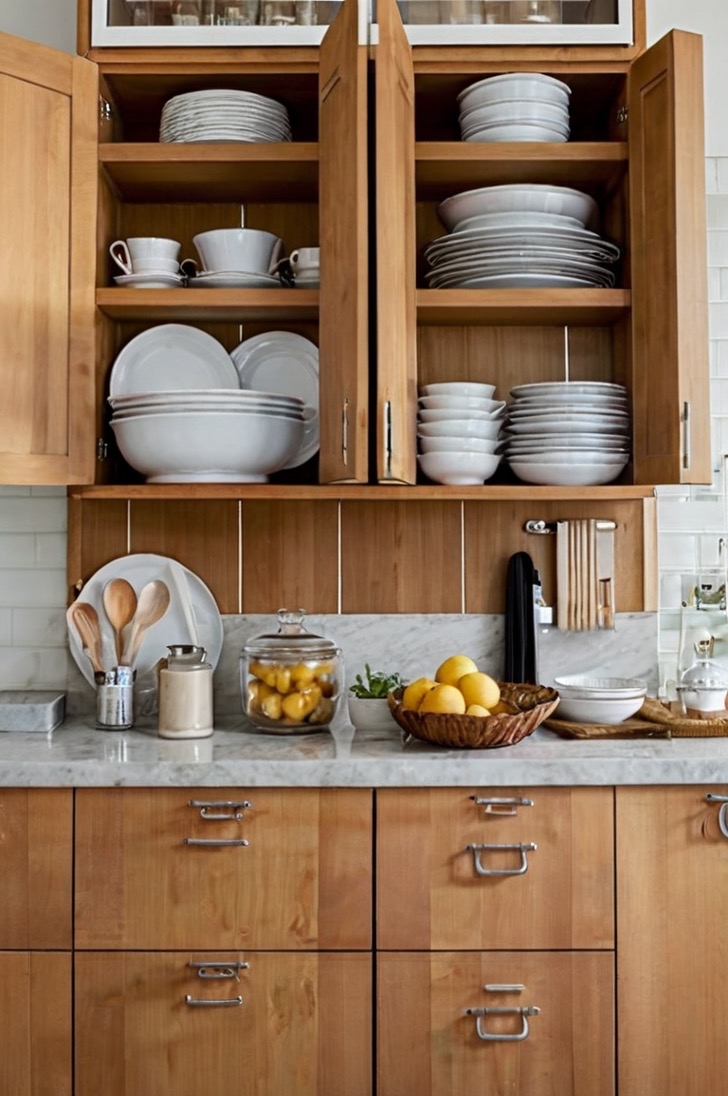
Kitchen cabinets can look surprisingly spacious when they’re empty.
Then you start putting things inside.
A few plates.
Several pans.
Food containers.
Mugs.
Spices.
Small appliances.
Cleaning supplies.
Suddenly, the cabinet that seemed enormous is packed, and you’re struggling to find the one thing you need.
The problem isn’t always a lack of cabinets.
Often, it’s that the available cabinet space isn’t being used efficiently.
Deep shelves can leave unused vertical space. Small items can disappear behind larger ones. Pots can become difficult to stack. Food containers can lose their lids. And awkward corners can become places where things are forgotten.
Fortunately, you don’t necessarily need a kitchen renovation to improve your storage.
A few thoughtful organization solutions can make your existing cabinets significantly easier to use.
Here are 11 practical ideas to help your kitchen storage work harder.
1. Add Shelf Risers to Create Another Level
One of the easiest ways to waste cabinet space is to have a large gap between the shelf and the items sitting below it.
A shelf riser can divide that vertical space into two usable levels.
For example, you might use one level for plates and the other for bowls.
Or one level for mugs and another for smaller serving pieces.
This can effectively create an additional storage surface without installing another permanent shelf.
The important part is measuring
Check the:
- Cabinet width
- Cabinet depth
- Available height
- Door clearance
The riser should fit comfortably without preventing the cabinet door from closing.
2. Store Baking Trays Vertically
Baking trays and chopping boards are much easier to use when they’re stored vertically rather than stacked into one large pile.
A suitable vertical divider can create individual slots for each item.
This means you can pull out one tray without removing everything above it.
It also makes the cabinet easier to see at a glance.
This works particularly well for:
- Baking sheets
- Chopping boards
- Serving trays
- Cooling racks
- Oven dishes
Use a storage system that can support the items securely and check its weight capacity.
3. Organize Pots and Pans by Frequency of Use
Pots and pans can take up a huge amount of cabinet space.
Rather than simply stacking everything together, think about what you use most often.
Your everyday frying pan might deserve the easiest access.
A large roasting dish you only use occasionally can go further back or into higher storage.
If appropriate for your cookware, a suitable rack or divider can also help separate pieces.
Avoid creating an impossible stack
If removing the bottom pan requires lifting five others out first, the system isn’t efficient.
Your goal should be:
The test
Pick up the pan you need → use it → return it easily.
4. Give Food Containers a Dedicated Zone
Food storage containers are notorious for creating kitchen chaos.
Different shapes.
Different sizes.
Missing lids.
Containers without matching pieces.
The solution is to give them one dedicated area.
Where possible, choose containers that stack or nest efficiently.
Then store the lids together in a way that keeps them visible.
A simple system
- Containers → stacked by size
- Lids → grouped vertically or in a dedicated section
This makes it much easier to find a matching set.
5. Use a Tiered Organizer for Spices
Spices are small, but they can be difficult to organize because you often have many of them.
If they’re stored in rows, the bottles at the back can disappear.
A tiered organizer raises the back rows, making more labels visible.
This means you can identify what you need without moving half the cabinet.
Organize based on your cooking habits
You could group spices by:
- Frequency of use
- Type
- Cuisine
- Alphabetical order
There isn’t one correct method.
Choose the system that allows you to find things fastest.
6. Use the Inside of Cabinet Doors
The inside of a suitable cabinet door can provide additional organization space.
Depending on the cabinet and the product, you might use the door for:
- Small spices
- Measuring spoons
- Cleaning tools
- Kitchen towels
- Lightweight accessories
This can be especially helpful when your shelves are already full.
Be careful with weight
Cabinet doors aren’t designed to support unlimited additional weight.
Use appropriate organizers and follow installation and weight-limit instructions.
Also make sure the added storage doesn’t interfere with the shelves or prevent the door from closing.
7. Create an Under-Sink Organization System
The cabinet underneath the kitchen sink is often one of the most awkward storage areas.
Pipes take up space.
The cabinet may be deep.
Cleaning products get pushed toward the back.
And small items disappear.
Instead of treating the entire cabinet as one large storage box, divide it into zones.
For example:
- Front: Everyday cleaning products
- Side: Cloths and sponges
- Back: Refills and less-used supplies
A suitable adjustable organizer can help work around plumbing.
Safety reminder
Store cleaning products according to their labels and keep them away from children and pets where required.
Never mix cleaning chemicals unless the manufacturer’s instructions specifically say the combination is safe.
8. Use Pull-Out Storage in Deep Cabinets
Deep cabinets can create a frustrating problem.
You can store plenty inside them, but reaching the things at the back is difficult.
A suitable pull-out organizer or rolling shelf can make deeper storage more accessible.
Instead of reaching into the cabinet, you pull the storage toward you.
This can be particularly useful for:
- Pantry ingredients
- Cleaning supplies
- Pots
- Bottles
- Bulk household items
Measure the full cabinet
Make sure you account for:
- Interior width
- Depth
- Height
- Door opening
- Hinges
- Fixed shelves
A pull-out solution is only useful if it can actually move freely.
9. Use Bins to Group Similar Pantry Items
Small pantry items can quickly become difficult to manage when they’re scattered across several shelves.
Bins can create simple categories.
For example:
- Breakfast: cereals, spreads and related items
- Baking: flour, sugar and baking ingredients
- Snacks: packaged snacks
- Cooking: commonly used ingredients
This makes it easier to find things and can also make restocking simpler.
Don’t over-categorize
You don’t need a separate basket for every food type.
Use broad categories that make sense for your household.
10. Make Use of the Space Above Your Cabinets
If your kitchen cabinets don’t reach the ceiling, the space above them can sometimes provide additional storage.
It can be suitable for items you use infrequently, such as:
- Seasonal serving pieces
- Large decorative kitchen items
- Occasional entertaining supplies
- Spare baskets
- Certain storage containers
Woven baskets can help conceal miscellaneous items and make the space look intentional.
But think about accessibility
If you need a step ladder every time you want something, don’t store everyday essentials there.
High storage is best reserved for things you rarely use.
11. Create a Dedicated Coffee or Tea Zone
If you make coffee or tea every day, consider keeping the things you use together.
A small section of a cabinet or shelf could contain:
- Coffee or tea
- Mugs
- Filters
- Sweeteners
- Measuring tools
- Frequently used accessories
This is an example of organizing around a routine rather than simply around objects.
Instead of opening several cabinets to prepare one drink, the most important items are conveniently grouped.
You could create similar zones for:
- Breakfast
- Baking
- Smoothies
- Meal preparation
The idea is to make your most common kitchen activities easier.
How to Make Kitchen Cabinets Easier to Maintain
Good organization isn’t only about fitting more into a cabinet.
It should also make the cabinet easier to use.
Keep everyday items within reach
Don’t put your most-used mug behind the things you use once a month.
Group similar items
Similar belongings are easier to find when they’re stored together.
Avoid overcrowding
If a cabinet is packed so tightly that removing one item causes several others to fall out, you have too much in that section.
Label where it genuinely helps
Labels can be particularly useful for opaque pantry bins or storage boxes.
But you don’t need labels on everything.
Review your storage occasionally
As your kitchen habits change, your storage system should change too.
What About Small Kitchens With Very Few Cabinets?
If your kitchen has limited cabinet space, you can combine cabinet organization with vertical and external storage.
Consider:
- A slim rolling cart
- Floating shelves
- Suitable wall rails
- Over-door storage
- A narrow pantry unit
- Stackable containers
- Under-shelf organizers
But don’t add storage simply because you have an empty wall.
Keep the room’s circulation and appearance in mind.
Before Buying Any Kitchen Organizer
Take five minutes to measure.
For cabinets
- Measure the usable width + depth + height
For drawers
- Measure the inside, not the outside.
For shelves
- Measure the gap between the shelf and the cabinet above it.
For pull-out storage
- Check whether hinges or doors affect the available width.
For under-sink storage
- Measure around the plumbing.
These small measurements can save you from buying products that don’t fit.
Final Thoughts
You don’t always need more kitchen cabinets.
Sometimes you need to make the cabinets you already have easier to access and more efficient.
A shelf riser can create another level.
A vertical divider can make baking trays easier to reach.
A pull-out organizer can make a deep cabinet practical.
A few pantry bins can turn a chaotic shelf into clear categories.
And a dedicated coffee station can make a daily routine much faster.
Smart Space Finds takeaway
Good kitchen storage isn’t about fitting the maximum number of things into a cabinet. It’s about making the things you actually use easy to see, reach and put away.
Start with the cabinet that frustrates you most, solve that problem first and build your organization system gradually.
For more ideas in the same spirit, explore the kitchen section, or keep going with our guide to 10 genius small-space storage ideas and the organization and small spaces sections.