A small closet can become frustrating surprisingly quickly.
You add a few new clothes, put away some seasonal pieces and suddenly you’re struggling to close the doors. Clothes disappear into crowded piles, shoes end up on the floor, and finding one particular item becomes a daily search.
The problem isn’t always that you don’t have enough closet space.
Sometimes, the space you already have simply isn’t being used efficiently.
A small closet needs a system that makes the available height, shelves, hanging space and floor area work harder. But it also needs to remain easy to maintain.
There’s little value in creating a beautifully organized wardrobe that takes ten minutes to put one shirt away.
The best closet system is one that makes getting dressed easier and keeps your clothes visible and accessible.
Here are 11 practical ideas for making a small closet work harder.
01. Start by Removing What You Don’t Wear
Before adding organizers, take a look at what’s actually inside the closet.
This is often the most effective step because every item you remove creates additional space.
You don’t have to become a minimalist or throw away half your wardrobe.
Instead, look for things such as:
- Clothes that no longer fit
- Items you haven’t worn in a long time
- Damaged pieces you never repaired
- Duplicates
- Items you bought but never really liked
- Seasonal pieces that belong elsewhere
Create separate groups for items you’re keeping, donating, repairing, recycling or deciding about later.
Why this matters
If you organize a closet that’s already overloaded, you’ll simply end up with an organized overloaded closet.
Create the space first. Then organize what remains.
02. Use Slim Hangers
One of the simplest ways to create additional hanging capacity is to replace bulky hangers with slim, consistent ones.
Traditional hangers can take up more horizontal space than necessary.
Slim hangers allow clothing to sit closer together while creating a more visually consistent wardrobe.
This can be particularly useful if your hanging rail is already crowded.
But don’t overfill the rail
There should still be enough room to remove clothes without pulling several other items off the rail.
The purpose is to use the available space efficiently—not to compress your wardrobe so tightly that nothing is easy to reach.
03. Create Double Hanging Space
Look at the clothing you hang.
Not everything needs the full vertical height of the closet.
Shorter garments such as:
- Shirts
- Blouses
- Foldable trousers
- Skirts
- Short jackets
can sometimes be arranged in a way that allows two hanging levels.
A suitable double-hanging solution can effectively turn one tall section into two useful zones.
Think about what belongs where
For example:
- Upper rail: shirts and tops
- Lower rail: trousers and skirts
This makes use of vertical space without requiring a larger wardrobe.
04. Use Shelf Dividers to Control Stacks
Folded clothing can quickly become messy when several piles are placed together.
You pull out one shirt from the bottom and suddenly the entire stack collapses.
Shelf dividers can help separate categories and keep piles upright.
They can work particularly well for:
- T-shirts
- Sweaters
- Handbags
- Towels
- Jeans
- Accessories
Instead of one large pile, create smaller, easier-to-manage sections.
Don’t make stacks too high
A lower stack is generally easier to maintain.
If you have to rebuild the entire pile every time you take one item, the system isn’t working efficiently.
05. Use the Back of the Closet Door
The inside of a closet door can provide additional storage without reducing the main hanging area.
Depending on the door and product, you could use suitable organizers for:
- Belts
- Scarves
- Handbags
- Jewelry
- Small accessories
- Shoes
This is particularly useful when your closet has limited shelving.
Check the clearance
Make sure the organizer doesn’t interfere with:
- Shelves
- Hanging clothes
- Hinges
- The door frame
A door organizer should add storage without preventing the closet from closing properly.
06. Organize Clothes by Category
If your closet is small, visibility becomes especially important.
Instead of randomly placing clothing wherever there is room, group similar items together.
For example:
Tops → Trousers → Dresses → Jackets
You can take this further by organizing according to how you dress.
For example, if you wear work clothes during the week and casual clothes on weekends, keeping related items together may make your morning routine easier.
The perfect system is the one that makes sense to you.
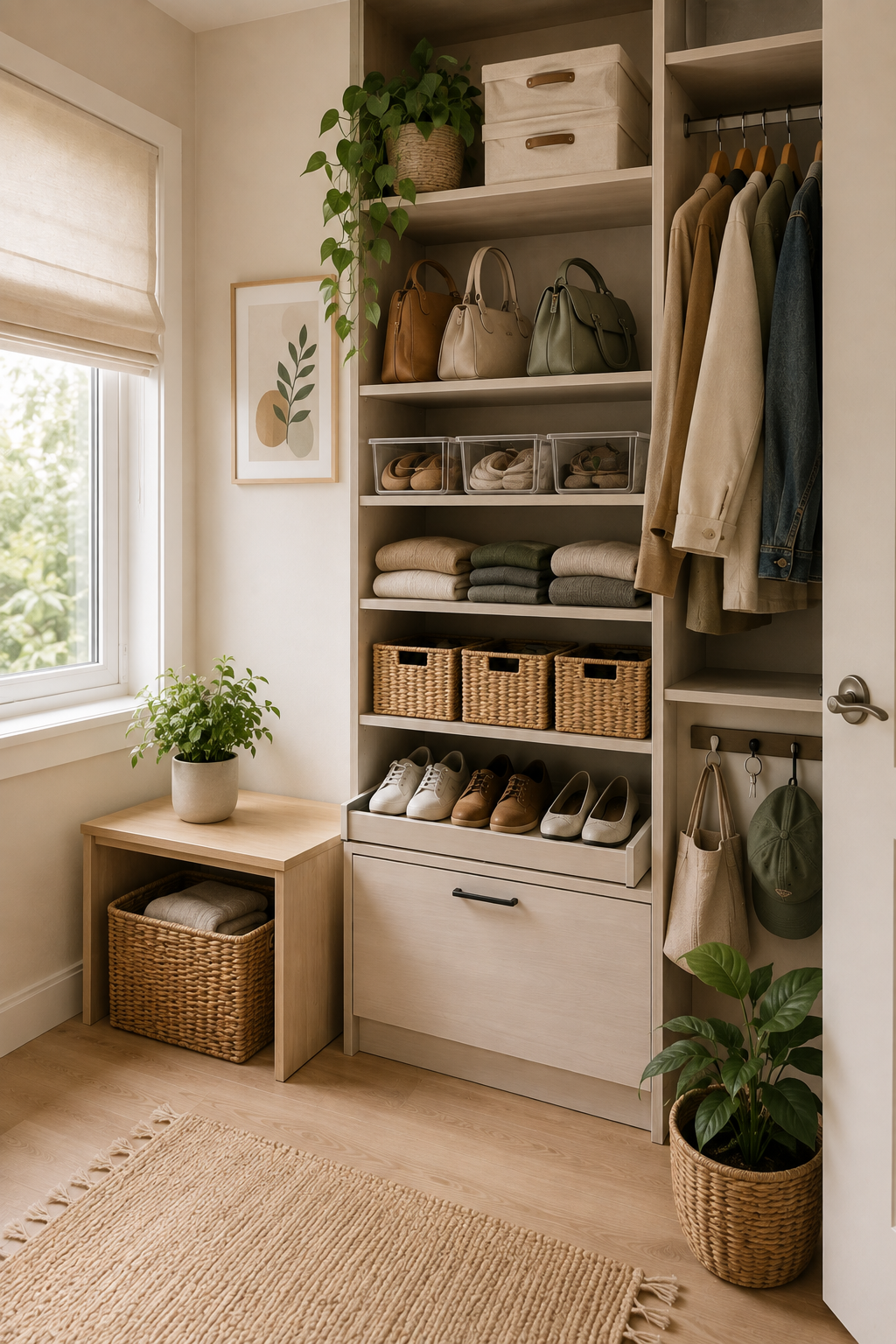
07. Use the Floor for Shoes—But Keep It Controlled
Shoes can quickly consume the bottom of a closet.
Instead of creating a pile, use a suitable shoe rack, vertical organizer or stackable solution.
The goal is to make every pair visible.
If you have several pairs that you rarely wear, consider moving seasonal or occasional shoes into another storage area.
Keep everyday pairs accessible
If you wear the same few pairs regularly, don’t bury them behind shoes you only use occasionally.
Closet organization should reflect your actual habits.
08. Use Baskets for Smaller Items
Small accessories are often the hardest things to organize.
Things such as:
- Scarves
- Belts
- Small handbags
- Hats
- Seasonal accessories
- Clothing-care items
can quickly become tangled or scattered.
Baskets provide a simple way to contain these categories.
You can place them on upper shelves or in suitable lower areas.
If the basket is opaque, a simple label can help you identify what’s inside without having to empty it.
09. Make Seasonal Clothing Work for You
Not every piece of clothing needs to occupy prime closet space all year.
If your climate and wardrobe require seasonal changes, rotate pieces when appropriate.
For example, items that aren’t currently needed can move to:
- Under-bed storage
- High closet shelves
- Storage boxes
- Another suitable wardrobe area
This gives your everyday clothing more breathing room.
Keep the rotation manageable
Don’t create a complicated seasonal system that requires an entire weekend to change.
The simpler the rotation, the more likely you’ll maintain it.
10. Use the Highest Shelves for Less-Frequently Used Items
The top shelf of a wardrobe is often difficult to access, so it shouldn’t be filled with everyday essentials.
Use it for belongings that you only need occasionally.
Examples include:
- Luggage
- Seasonal clothing
- Special-occasion accessories
- Spare bedding
- Storage bags
A sturdy basket or box can keep these items contained.
Make them easy to identify
If you use opaque containers, labels can save you from pulling down every box just to find one item.
11. Organize Around How You Get Dressed
This is where closet organization becomes genuinely personal.
You can have the most beautiful wardrobe system in the world, but if it doesn’t match your routine, it won’t make life easier.
Think about how you actually choose an outfit.
Do you normally select:
- A top first?
- A complete outfit?
- Workwear?
- Casual clothing?
- Clothing based on color?
- Clothing based on occasion?
Arrange your closet accordingly.
For example, if you regularly wear complete outfits together, keeping complementary pieces close can reduce the time spent searching.
If you choose clothing by category, keep similar garments grouped together.
Your closet should support your routine, not dictate it.
How to Make a Small Closet Feel Bigger
Organization isn’t only about capacity.
It’s also about visibility.
A closet can contain plenty of clothing but still feel impossible to use when everything is crowded together.
Here are a few ways to improve the feeling of space.
Keep some breathing room
Don’t pack every shelf and hanging rail to maximum capacity.
Use consistent storage
Matching or coordinated baskets can reduce visual noise.
Keep frequently used items accessible
You shouldn’t have to move five things to reach something you wear every week.
Fold items appropriately
Some garments are better folded, while others benefit from hanging. Follow care instructions where applicable.
Keep the floor clear
A clean closet floor makes it easier to access shoes and storage boxes.
Common Closet Organization Mistakes
Buying organizers before measuring
A container that is too wide or too tall becomes another problem.
Measure your shelves, drawers and hanging sections first.
Trying to keep everything
Storage can only solve so much.
If your wardrobe contains many items you don’t use, no organizer will magically create enough space.
Making categories too complicated
If putting something away requires several decisions, you’ll eventually stop following the system.
Ignoring accessibility
Beautiful storage isn’t useful if you can’t comfortably reach it.
Overpacking
More capacity isn’t the same thing as better organization.
Leave enough room to see and remove your belongings easily.
Final Thoughts
A small closet doesn’t have to feel impossible to manage.
The biggest improvement often comes from combining several small changes: removing unused clothing, using slimmer hangers, making better use of vertical space, controlling folded stacks and keeping accessories contained.
But don’t try to create the most sophisticated wardrobe system possible.
Create one that makes your mornings easier.
Smart Space Finds takeaway
The goal isn’t to fit more clothes into your closet. It’s to make the clothes you actually wear easier to see, reach and put away.
When your closet reflects your real routine, even a small wardrobe can feel surprisingly functional.
For more ideas in the same spirit, keep going with our guide to 10 genius small-space storage ideas, or explore the organization, bedroom and small spaces sections.